Python Threading Wouldn t Continue With Main Function
Summary: in this tutorial, you'll learn how to use the Python threading module to develop multi-threaded applications.
Single-threaded applications
Let's start with a simple program:
def task (): start_time = perf_counter() task() end_time = perf_counter() from time import sleep, perf_counter
print('Starting a task...')
sleep(1)
print('done')
task()
print(f'It took {end_time- start_time: 0.2f} second(s) to complete.')
Code language: Python ( python )
How it works.
First, import the sleep() and perf_counter() functions from the time module:
from time import sleep, perf_counter
Code language: Python ( python )
Second, define a function that takes one second to complete:
                                  def                  task                  ():
                print('Starting a task...')
                sleep(1)
                print('done')
Code language: Python ( python )
Third, get the value of the performance counter by calling the perf_counter() function:
start_time = perf_counter()
Code language: Python ( python )
Fourth, call the task() function twice:
task()
                task()
Code language: Python ( python )
Fifth, get the value of the performance counter by calling the perf_counter() function:
end_time = perf_counter()
Code language: Python ( python )
Finally, output the time that takes to complete running the task() function twice:
print(f'It took {end_time- start_time: 0.2f} second(s) to complete.')
Code language: Python ( python )
Here is the output:
Starting a task...
                done
                Starting a task...
                done
                It took                2.00                second(s) to complete.
Code language: Python ( python )
As you may expect, the program takes about two seconds to complete. If you call the task() function 10 times, it would take about 10 seconds to complete.
The following diagram illustrates how the program works:
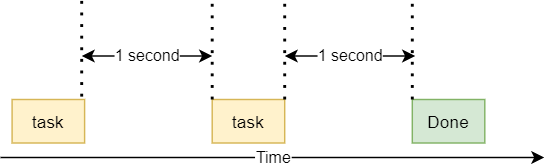
First, the task() function executes and sleeps for one second. Then it executes the second time and also sleeps for another second. Finally, the program completes.
When the task() function calls the sleep() function, the CPU is idle. In other words, the CPU doesn't do anything, which is not efficient in terms of resource utilization.
This program has one process with a single thread, which is called the main thread. Because the program has only one thread, it's called the single-threaded program.
Using Python threading to develop a multi-threaded program example
To create a multi-threaded program, you need to use the Python threading module.
First, import the Thread class from the threading module:
from threading import Thread
Code language: Python ( python )
Second, create a new thread by instantiating an instance of the Thread class:
new_thread = Thread(target=fn,args=args_tuple)
Code language: Python ( python )
The Thread() accepts many parameters. The main ones are:
-
target: specifies a function (fn) to run in the new thread. -
args: specifies the arguments of the function (fn). Theargsargument is a tuple.
Third, start the thread by calling the start() method of the Thread instance:
new_thread.start()
Code language: Python ( python )
If you want to wait for the thread to complete in the main thread, you can call the join() method:
new_thread.join()
Code language: Python ( python )
By calling the join() method, the main thread will wait for the second thread to complete before it is terminated.
The following program illustrates how to use the threading module:
def task (): start_time = perf_counter() # create two new threads # start the threads # wait for the threads to complete end_time = perf_counter() from time import sleep, perf_counter
from threading import Thread
print('Starting a task...')
sleep(1)
print('done')
t1 = Thread(target=task)
                t2 = Thread(target=task)
t1.start()
                t2.start()
t1.join()
                t2.join()
print(f'It took {end_time- start_time: 0.2f} second(s) to complete.')
Code language: Python ( python )
How it works. (and we'll focus on the threading part only)
First, create two new threads:
t1 = Thread(target=task)
t2 = Thread(target=task)
Second, start both threads by calling the start() method:
t1.start()
t2.start()
Code language: Python ( python )
Third, wait for both threads to complete:
t1.join()
t2.join()
Code language: Python ( python )
Finally, show the executing time:
print(f'It took {end_time- start_time: 0.2f} second(s) to complete.')
Code language: Python ( python )
Output:
Starting a task...
                Starting a task...
                done
                done
                It took                1.00                second(s) to complete.
Code language: Python ( python )
When the program executes, it'll have three threads: the main thread is created by the Python interpreter, and two threads are created by the program.
As shown clearly from the output, the program took one second instead of two to complete.
The following diagram shows how threads execute:
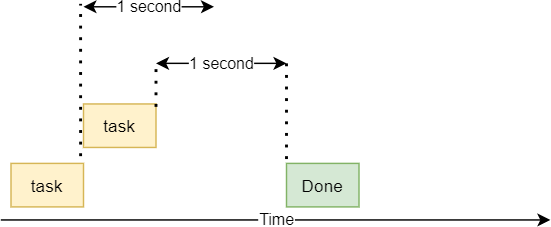
Passing arguments to threads
The following program shows how to pass arguments to the function assigned to a thread:
def task (id): start_time = perf_counter() # create and start 10 threads # wait for the threads to complete end_time = perf_counter() from time import sleep, perf_counter
from threading import Thread
print(f'Starting the task {id}...')
sleep(1)
print(f'The task {id} completed')
threads = []
for n in range(1, 11):
t = Thread(target=task, args=(n,))
threads.append(t)
t.start()
for t in threads:
t.join()
print(f'It took {end_time- start_time: 0.2f} second(s) to complete.')
Code language: Python ( python )
How it works.
First, define a task() function that accepts an argument:
                                  def                  task                  (id):
                print(f'Starting the task                  {id}...')
                sleep(1)
                print(f'The task                  {id}                  completed')
Code language: Python ( python )
Second, create 10 new threads and pass an id to each. The threads list is used to keep track of all newly created threads:
threads = []
                for                n                in                range(1,                11):
                t = Thread(target=task, args=(n,))
                threads.append(t)
                t.start()
Code language: Python ( python )
Notice that if you call the join() method inside the loop, the program will wait for the first thread to complete before starting the next one.
Third, wait for all threads to complete by calling the join() method:
                for                t                in                threads:
                t.join()
Code language: Python ( python )
The following shows the output of the program:
Starting the task                1...
                Starting the task                2...
                Starting the task                3...
                Starting the task                4...
                Starting the task                5...
                Starting the task                6...
                Starting the task                7...
                Starting the task                8...
                Starting the task                9...
                Starting the task                10...
                The task                10                completed
                The task                8                completed
                The task                1                completed
                The task                6                completed
                The task                7                completed
                The task                9                completed
                The task                3                completed
                The task                4                completed
                The task                2                completed
                The task                5                completed
                It took                1.02                second(s) to complete.
Code language: Python ( python )
It just took 1.05 seconds to complete.
Notice that the program doesn't execute the thread in the order from 1 to 10.
When to use Python threading
As introduced in the process and thread tutorial, there're two main tasks:
- I/O-bound tasks – the time spent on I/O is significantly more than the time spent on computation
- CPU-bound tasks – the time spent on computation is significantly higher than the time waiting for I/O.
Python threading is optimized for I/O bound tasks. For example, requesting remote resources, connecting a database server, or reading and writing files.
A Practical Python threading example
Suppose that you have a list of text files in a folder e.g., C:/temp/. And you want to replace a text with a new one in all the files.
The following single-threaded program shows how to replace a substring with the new one in the text files:
def replace (filename, substr, new_substr): # replace the substr by new_substr # write data into the file def main (): for filename in filenames: if __name__ == "__main__": main() from time import perf_counter
print(f'Processing the file {filename}')
# get the contents of the file
with open(filename, 'r') as f:
content = f.read()
content = content.replace(substr, new_substr)
with open(filename, 'w') as f:
f.write(content)
filenames = [
'c:/temp/test1.txt',
'c:/temp/test2.txt',
'c:/temp/test3.txt',
'c:/temp/test4.txt',
'c:/temp/test5.txt',
'c:/temp/test6.txt',
'c:/temp/test7.txt',
'c:/temp/test8.txt',
'c:/temp/test9.txt',
'c:/temp/test10.txt',
]
replace(filename, 'ids', 'id')
start_time = perf_counter()
                  end_time = perf_counter()
                  print(f'It took                    {end_time- start_time :0.2f}                    second(s) to complete.')
Code language: Python ( python )
Output:
It took 0.16 second(s) to complete.
Code language: Python ( python )
The following program has the same functionality. However, it uses multiple threads instead:
def replace (filename, substr, new_substr): # replace the substr by new_substr # write data into the file def main (): # create threads # start the threads # wait for the threads to complete if __name__ == "__main__": main() from threading import Thread
from time import perf_counter
print(f'Processing the file {filename}')
# get the contents of the file
with open(filename, 'r') as f:
content = f.read()
content = content.replace(substr, new_substr)
with open(filename, 'w') as f:
f.write(content)
filenames = [
'c:/temp/test1.txt',
'c:/temp/test2.txt',
'c:/temp/test3.txt',
'c:/temp/test4.txt',
'c:/temp/test5.txt',
'c:/temp/test6.txt',
'c:/temp/test7.txt',
'c:/temp/test8.txt',
'c:/temp/test9.txt',
'c:/temp/test10.txt',
]
threads = [Thread(target=replace, args=(filename, 'id', 'ids'))
for filename in filenames]
for thread in threads:
thread.start()
for thread in threads:
thread.join()
start_time = perf_counter()
                  end_time = perf_counter()
                  print(f'It took                    {end_time- start_time :0.2f}                    second(s) to complete.')
Code language: Python ( python )
Output:
Processing the file c:/temp/test1.txt
                Processing the file c:/temp/test2.txt
                Processing the file c:/temp/test3.txt
                Processing the file c:/temp/test4.txt
                Processing the file c:/temp/test5.txt
                Processing the file c:/temp/test6.txt
                Processing the file c:/temp/test7.txt
                Processing the file c:/temp/test8.txt
                Processing the file c:/temp/test9.txt
                Processing the file c:/temp/test10.txt
                It took                0.02                second(s) to complete.
Code language: Python ( python )
As you can see clearly from the output, the multi-threaded program runs so much faster.
Summary
- Use the Python
threadingmodule to create a multi-threaded application. - Use the
Thread(function, args)to create a new thread. - Call the
start()method of theThreadclass to start the thread. - Call the
join()method of theThreadclass to wait for the thread to complete in the main thread. - Only use threading for I/O bound processing applications.
duquettehavol1984.blogspot.com
Source: https://python-tutorials.in/python-threading/
0 Response to "Python Threading Wouldn t Continue With Main Function"
Publicar un comentario