Why Must a Capacitor Be in Front Resistor to Read the Voltage Drop of the Resistor
6.2 Resistors in Serial and Parallel
LEARNING OBJECTIVES
- Define the term equivalent resistance
- Summate the equivalent resistance of resistors connected in series
- Summate the equivalent resistance of resistors continued in parallel
In Current and Resistance, nosotros described the term 'resistance' and explained the bones design of a resistor. Basically, a resistor limits the flow of charge in a circuit and is an ohmic device where  . Nearly circuits take more than i resistor. If several resistors are continued together and connected to a battery, the current supplied by the battery depends on the equivalent resistance of the circuit.
The equivalent resistance of a combination of resistors depends on both their individual values and how they are connected. The simplest combinations of resistors are series and parallel connections (Effigy 6.2.i). In a serial excursion , the output current of the get-go resistor flows into the input of the second resistor; therefore, the current is the same in each resistor. In a parallel excursion , all of the resistor leads on one side of the resistors are connected together and all the leads on the other side are connected together. In the case of a parallel configuration, each resistor has the aforementioned potential drib across information technology, and the currents through each resistor may exist different, depending on the resistor. The sum of the private currents equals the current that flows into the parallel connections.
(Figure 6.2.1) 
Resistors in Serial
Resistors are said to be in serial whenever the current flows through the resistors sequentially. Consider Effigy 6.2.2, which shows three resistors in series with an practical voltage equal to  . Since there is only one path for the charges to flow through, the current is the same through each resistor. The equivalent resistance of a prepare of resistors in a series connection is equal to the algebraic sum of the individual resistances.
(Figure half dozen.2.2) 
In Figure 6.2.2, the current coming from the voltage source flows through each resistor, and then the current through each resistor is the same. The current through the circuit depends on the voltage supplied by the voltage source and the resistance of the resistors. For each resistor, a potential drop occurs that is equal to the loss of electric potential free energy as a current travels through each resistor. According to Ohm's constabulary, the potential drib  across a resistor when a current flows through it is calculated using the equation , where
  is the current in amps (
 ) and
) and  is the resistance in ohms (
 ). Since free energy is conserved, and the voltage is equal to the potential energy per charge, the sum of the voltage applied to the circuit past the source and the potential drops beyond the individual resistors around a loop should exist equal to zero:
![\[\sum_{i=1}^{N}V_i=0.\]](https://openpress.usask.ca/app/uploads/quicklatex/quicklatex.com-1b9fc449151e9db20d8ee3e8f67a1e96_l3.png "Rendered by QuickLaTeX.com")
This equation is oftentimes referred to as Kirchhoff'southward loop law, which we will look at in more detail later on in this chapter. For Figure 6.2.2 , the sum of the potential driblet of each resistor and the voltage supplied by the voltage source should equal goose egg:
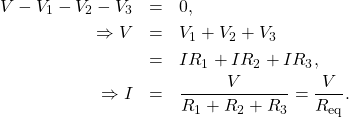
Since the current through each component is the same, the equality can be simplified to an equivalent resistance, which is but the sum of the resistances of the private resistors.
Any number of resistors can be connected in series. If  resistors are continued in series, the equivalent resistance is
(6.two.1) 
One event of components connected in a series excursion is that if something happens to one component, it affects all the other components. For instance, if several lamps are connected in series and one bulb burns out, all the other lamps go dark.
EXAMPLE 6.2.1
Equivalent Resistance, Current, and Power in a Serial Circuit
A battery with a terminal voltage of  is continued to a circuit consisting of 4
  and one
 resistors all in series (Figure 6.2.3). Assume the battery has negligible internal resistance. (a) Calculate the equivalent resistance of the circuit. (b) Summate the electric current through each resistor. (c) Calculate the potential drib beyond each resistor. (d) Determine the total ability dissipated by the resistors and the ability supplied by the bombardment.
(Effigy 6.ii.iii) 
Strategy
In a serial circuit, the equivalent resistance is the algebraic sum of the resistances. The current through the circuit can be establish from Ohm's law and is equal to the voltage divided past the equivalent resistance. The potential drop across each resistor tin be constitute using Ohm's law. The ability dissipated past each resistor can be found using  , and the total power dissipated past the resistors is equal to the sum of the power dissipated by each resistor. The power supplied by the bombardment can be institute using
  .
.
Solution
a. The equivalent resistance is the algebraic sum of the resistances:
![\[R_{\mathrm{eq}}=R_1+R_2+R_3+R_4+R_5=20~\Omega+20~\Omega+20~\Omega+20~\Omega+10~\Omega=90~\Omega\]](https://openpress.usask.ca/app/uploads/quicklatex/quicklatex.com-1f8ed2a3638646e0e58e4d0d7619d283_l3.png "Rendered by QuickLaTeX.com")
b. The current through the circuit is the same for each resistor in a series circuit and is equal to the practical voltage divided past the equivalent resistance:
![\[I=\frac{V}{R_{\mathrm{eq}}}=\frac{9~\mathrm{V}}{90~\Omega}=0.1~\mathrm{A}.\]](https://openpress.usask.ca/app/uploads/quicklatex/quicklatex.com-f1fe30ab36a39cbe97ceabfab169936c_l3.png "Rendered by QuickLaTeX.com")
c. The potential drop across each resistor can be establish using Ohm's law:
![\[V_1=V_2=V_3=V_4=(0.1~\mathrm{A})20~\Omega=2~\mathrm{V},\]](https://openpress.usask.ca/app/uploads/quicklatex/quicklatex.com-2e11ce559627d8e0a6315284d6e204d8_l3.png "Rendered by QuickLaTeX.com")
![\[V_5=(0.1~\mathrm{A})10~\Omega=1~\mathrm{V},\]](https://openpress.usask.ca/app/uploads/quicklatex/quicklatex.com-2aad772f12d57c491e7bfab3c704215a_l3.png "Rendered by QuickLaTeX.com")
![\[V_1+V_2+V_3+V_4+V_5=9~\mathrm{V}.\]](https://openpress.usask.ca/app/uploads/quicklatex/quicklatex.com-7a4a4980cf04ed44bf6b09227f1e0b64_l3.png "Rendered by QuickLaTeX.com")
Annotation that the sum of the potential drops across each resistor is equal to the voltage supplied by the bombardment.
d. The power dissipated by a resistor is equal to , and the power supplied by the bombardment is equal to :
![\[P_1=P_2=P_3=P_4=(0.1~\mathrm{A})^2(20~\Omega)=0.2~\mathrm{W},\]](https://openpress.usask.ca/app/uploads/quicklatex/quicklatex.com-df0951f81b1511b10accdb751eea0f73_l3.png "Rendered by QuickLaTeX.com")
![\[P_5=(0.1~\mathrm{A})^2(10~\Omega)=0.1~\mathrm{W},\]](https://openpress.usask.ca/app/uploads/quicklatex/quicklatex.com-6679790d98f55770f60b65785f50bac5_l3.png "Rendered by QuickLaTeX.com")
![\[P_{\mathrm{dissipated}}=0.2~\mathrm{W}+0.2~\mathrm{W}+0.2~\mathrm{W}+0.2~\mathrm{W}+0.1~\mathrm{W}=0.9~\mathrm{W},\]](https://openpress.usask.ca/app/uploads/quicklatex/quicklatex.com-c52d4c036e0ff8f5d4f087435f1bb982_l3.png "Rendered by QuickLaTeX.com")
![\[P_{\mathrm{source}}=I\mathcal{E}=(0.1~\mathrm{A})(9~\mathrm{V})=0.9~\mathrm{W}.\]](https://openpress.usask.ca/app/uploads/quicklatex/quicklatex.com-9093034f523c651f7afddc5bc7c61d26_l3.png "Rendered by QuickLaTeX.com")
Significance
At that place are several reasons why we would use multiple resistors instead of simply 1 resistor with a resistance equal to the equivalent resistance of the circuit. Perhaps a resistor of the required size is not available, or we need to dissipate the heat generated, or nosotros want to minimize the toll of resistors. Each resistor may cost a few cents to a few dollars, but when multiplied past thousands of units, the cost saving may be appreciable.
CHECK YOUR Agreement 6.ii
Some strings of miniature holiday lights are made to short out when a bulb burns out. The device that causes the brusque is called a shunt, which allows current to flow effectually the open up circuit. A "short" is like putting a piece of wire across the component. The bulbs are commonly grouped in series of nine bulbs. If as well many bulbs burn out, the shunts eventually open up. What causes this?
Permit's briefly summarize the major features of resistors in serial:
- Series resistances add together to get the equivalent resistance:
![\[R_{\mathrm{eq}}=R_1+R_2+R_3+\ldots+R_{N-1}+R_N=\sum_{i=1}^NR_i.\]](https://openpress.usask.ca/app/uploads/quicklatex/quicklatex.com-ccd9d7edd470bfe1139f95c65eceac67_l3.png "Rendered by QuickLaTeX.com")
- The same current flows through each resistor in series.
- Private resistors in series exercise not go the total source voltage, but divide it. The total potential drop beyond a serial configuration of resistors is equal to the sum of the potential drops beyond each resistor.
Resistors in Parallel
Figure six.two.4shows resistors in parallel, wired to a voltage source. Resistors are in parallel when one end of all the resistors are connected by a continuous wire of negligible resistance and the other end of all the resistors are also connected to one another through a continuous wire of negligible resistance. The potential drop across each resistor is the same. Current through each resistor can be found using Ohm's law  , where the voltage is constant across each resistor. For case, an machine's headlights, radio, and other systems are wired in parallel, so that each subsystem utilizes the full voltage of the source and can operate completely independently. The same is truthful of the wiring in your business firm or whatever building.
(Figure 6.2.4) 
The current flowing from the voltage source in Figure vi.2.4 depends on the voltage supplied past the voltage source and the equivalent resistance of the circuit. In this example, the current flows from the voltage source and enters a junction, or node, where the circuit splits flowing through resistors  and
and  . Every bit the charges flow from the battery, some get through resistor and some flow through resistor . The sum of the currents flowing into a junction must be equal to the sum of the currents flowing out of the junction:
![\[\sum I_{\mathrm{in}}=\sum I_{\mathrm{out}}.\]](https://openpress.usask.ca/app/uploads/quicklatex/quicklatex.com-521e28a93e7a680317b3b591fb777501_l3.png "Rendered by QuickLaTeX.com")
This equation is referred to as Kirchhoff's junction dominion and will exist discussed in detail in the side by side department. In Effigy half dozen.2.4, the junction rule gives  . There are two loops in this circuit, which leads to the equations
  and
and  Notation the voltage beyond the resistors in parallel are the same (
 ) and the electric current is condiment:
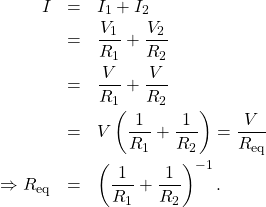
Generalizing to whatsoever number of resistors, the equivalent resistance  of a parallel connection is related to the private resistances past
(six.2.ii) 
This relationship results in an equivalent resistance that is less than the smallest of the private resistances. When resistors are continued in parallel, more current flows from the source than would flow for any of them individually, so the full resistance is lower.
EXAMPLE six.2.ii
Assay of a Parallel Excursion
Iii resistors  ,
, , and
, and are connected in parallel. The parallel connexion is attached to a
  voltage source. (a) What is the equivalent resistance? (b) Find the current supplied past the source to the parallel circuit. (c) Summate the currents in each resistor and show that these add together together to equal the current output of the source. (d) Calculate the power prodigal by each resistor. (e) Find the power output of the source and show that it equals the full power dissipated by the resistors.
Strategy
(a) The total resistance for a parallel combination of resistors is plant using 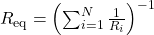 .
.
(Note that in these calculations, each intermediate answer is shown with an extra digit.)
(b) The current supplied by the source can be establish from Ohm's police, substituting for the total resistance  .
.
(c) The individual currents are hands calculated from Ohm's law  , since each resistor gets the full voltage. The full electric current is the sum of the individual currents:
  .
.
(d) The ability dissipated by each resistor can be plant using whatever of the equations relating ability to current, voltage, and resistance, since all three are known. Let united states of america use  , since each resistor gets total voltage.
(e) The total power can besides exist calculated in several ways, use  .
.
Solution
a. The total resistance for a parallel combination of resistors is constitute using Equation 6.two.2. Entering known values gives
![\[R_{\mathrm{eq}}&=&\left(\frac{1}{R_1}+\frac{1}{R_2}+\frac{1}{R_3}\right)^{-1}=\left(\frac{1}{1.00~\Omega}+\frac{1}{2.00~\Omega}+\frac{1}{2.00~\Omega}\right)^{-1}=0.50~\Omega.\]](https://openpress.usask.ca/app/uploads/quicklatex/quicklatex.com-b33f6191ae36b24af1b9ba2360c3912d_l3.png "Rendered by QuickLaTeX.com")
The total resistance with the right number of significant digits is  . Every bit predicted, is less than the smallest private resistance.
b. The total current tin exist found from Ohm'southward police force, substituting for the total resistance. This gives
![\[I=\frac{V}{R_{\mathrm{eq}}}=\frac{3.00~\mathrm{V}}{0.50~\Omega}=6.00~\mathrm{A}.\]](https://openpress.usask.ca/app/uploads/quicklatex/quicklatex.com-830c3d57c42b197db56e611dd2ef554f_l3.png "Rendered by QuickLaTeX.com")
Current for each device is much larger than for the same devices connected in serial (encounter the previous example). A circuit with parallel connections has a smaller total resistance than the resistors connected in serial.
c. The private currents are easily calculated from Ohm'due south law, since each resistor gets the full voltage. Thus,
![\[I_1=\frac{V}{R_1}=\frac{3.00~\mathrm{V}}{1.00~\Omega}=3.00~\mathrm{A}.\]](https://openpress.usask.ca/app/uploads/quicklatex/quicklatex.com-213ba5e9f7ba27abeed1d560d1399b55_l3.png "Rendered by QuickLaTeX.com")
Similarly,
![\[I_2=\frac{V}{R_2}=\frac{3.00~\mathrm{V}}{2.00~\Omega}=1.50~\mathrm{A}.\]](https://openpress.usask.ca/app/uploads/quicklatex/quicklatex.com-66172fd602c650fc1d0b31af024f188d_l3.png "Rendered by QuickLaTeX.com")
and
![\[I_3=\frac{V}{R_3}=\frac{3.00~\mathrm{V}}{2.00~\Omega}=1.50~\mathrm{A}.\]](https://openpress.usask.ca/app/uploads/quicklatex/quicklatex.com-ba01e79661b93c62b51dcbce213c397c_l3.png "Rendered by QuickLaTeX.com")
The total current is the sum of the individual currents:
![\[I_1+I_2+I_3=6.00~\mathrm{A}.\]](https://openpress.usask.ca/app/uploads/quicklatex/quicklatex.com-fbe0fe0764d46c0517f8601367e1c7d4_l3.png "Rendered by QuickLaTeX.com")
d. The power dissipated by each resistor tin exist found using whatsoever of the equations relating power to electric current, voltage, and resistance, since all three are known. Let united states utilize  , since each resistor gets full voltage. Thus,
![\[P_1=\frac{V^2}{R_1}=\frac{(3.00~\mathrm{V})^2}{1.00~\Omega}=9.00~\mathrm{W}.\]](https://openpress.usask.ca/app/uploads/quicklatex/quicklatex.com-39293a1755162e30413ccfd25cba3f51_l3.png "Rendered by QuickLaTeX.com")
Similarly,
![\[P_2=\frac{V^2}{R_2}=\frac{(3.00~\mathrm{V})^2}{2.00~\Omega}=4.50~\mathrm{W}.\]](https://openpress.usask.ca/app/uploads/quicklatex/quicklatex.com-5a63568c9759b30f12649e2f7913a892_l3.png "Rendered by QuickLaTeX.com")
and
![\[P_3=\frac{V^2}{R_3}=\frac{(3.00~\mathrm{V})^2}{2.00~\Omega}=4.50~\mathrm{W}.\]](https://openpress.usask.ca/app/uploads/quicklatex/quicklatex.com-65d894833d1efd19b437f375affb1e5c_l3.png "Rendered by QuickLaTeX.com")
e. The total ability can too be calculated in several ways. Choosing and entering the total current yields
![\[P=IV=(6.00~\mathrm{A})(3.00~\mathrm{V})=18.00~\mathrm{W}.\]](https://openpress.usask.ca/app/uploads/quicklatex/quicklatex.com-661f5ac85be187c988ba135bda2f2b8b_l3.png "Rendered by QuickLaTeX.com")
Significance
Full power prodigal by the resistors is also  :
:
![\[P_1+P_2+P_3=9.00~\mathrm{W}+4.50~\mathrm{W}+4.50~\mathrm{W}=18.00~\mathrm{W}\]](https://openpress.usask.ca/app/uploads/quicklatex/quicklatex.com-e5e677ec0e1597e5fa9ccc27ed216132_l3.png "Rendered by QuickLaTeX.com")
Notice that the total ability dissipated by the resistors equals the power supplied by the source.
CHECK YOUR Agreement 6 .3
Consider the same potential difference  practical to the same 3 resistors connected in series. Would the equivalent resistance of the serial circuit exist higher, lower, or equal to the three resistor in parallel? Would the current through the series excursion be higher, lower, or equal to the current provided past the same voltage applied to the parallel circuit? How would the ability dissipated past the resistor in serial compare to the power dissipated by the resistors in parallel?
Bank check YOUR UNDERSTANDING 6.iv
How would you lot use a river and two waterfalls to model a parallel configuration of two resistors? How does this illustration break downwards?
Permit us summarize the major features of resistors in parallel:
- Equivalent resistance is found from
![\[R_{\mathrm{eq}}&=&\left(\frac{1}{R_1}+\frac{1}{R_2}+\frac{1}{R_3}+\ldots+\frac{1}{R_{N-1}}+\frac{1}{R_N}\right)^{-1}=\left(\sum_{i=1}^N\frac{1}{R_i}\right)^{-1},\]](https://openpress.usask.ca/app/uploads/quicklatex/quicklatex.com-eba2a68daf87199e80d2f814719a3ade_l3.png "Rendered by QuickLaTeX.com")
and is smaller than whatever individual resistance in the combination.
- The potential drop across each resistor in parallel is the aforementioned.
- Parallel resistors practise not each get the total current; they divide it. The current entering a parallel combination of resistors is equal to the sum of the electric current through each resistor in parallel.
In this chapter, we introduced the equivalent resistance of resistors connect in serial and resistors connected in parallel. You lot may retrieve that in Capacitance, we introduced the equivalent capacitance of capacitors connected in series and parallel. Circuits often contain both capacitors and resistors. Table six.two.1 summarizes the equations used for the equivalent resistance and equivalent capacitance for series and parallel connections.
(Table half dozen.ii.ane) 
Combinations of Series and Parallel
More than complex connections of resistors are often just combinations of serial and parallel connections. Such combinations are mutual, especially when wire resistance is considered. In that instance, wire resistance is in series with other resistances that are in parallel.
Combinations of series and parallel can be reduced to a unmarried equivalent resistance using the technique illustrated inFigure 6.2.v. Various parts can be identified every bit either series or parallel connections, reduced to their equivalent resistances, and so further reduced until a single equivalent resistance is left. The process is more than fourth dimension consuming than difficult. Here, we notation the equivalent resistance every bit .
(Figure 6.2.5) 
Find that resistors  and
and  are in serial. They tin can be combined into a unmarried equivalent resistance. Ane method of keeping rail of the process is to include the resistors as subscripts. Here the equivalent resistance of and is
![\[R_{34}=R_3+R_4=6~\Omega+4~\Omega=10~\Omega.\]](https://openpress.usask.ca/app/uploads/quicklatex/quicklatex.com-cdaf69a183bf0cbd4bad854f22570b68_l3.png "Rendered by QuickLaTeX.com")
The excursion now reduces to three resistors, shown in Figure 6.two.5(c). Redrawing, we now see that resistors and  institute a parallel circuit. Those two resistors can be reduced to an equivalent resistance:
![\[R_{234}=\left(\frac{1}{R_2}+\frac{1}{R_{34}}\right)^{-1}=\left(\frac{1}{10~\Omega}+\frac{1}{10~\Omega}\right)^{-1}=5~\Omega.\]](https://openpress.usask.ca/app/uploads/quicklatex/quicklatex.com-0760c373b525199db5c8acc0678d4750_l3.png "Rendered by QuickLaTeX.com")
This step of the process reduces the excursion to two resistors, shown in in Effigy 6.2.5 (d). Hither, the circuit reduces to two resistors, which in this case are in series. These ii resistors can be reduced to an equivalent resistance, which is the equivalent resistance of the circuit:
![\[R_{\mathrm{eq}}=R_{1234}=R_1+R_{234}=7~\Omega+5~\Omega=12~\Omega.\]](https://openpress.usask.ca/app/uploads/quicklatex/quicklatex.com-8ac1a362f30b4dd70d5279e7c871189d_l3.png "Rendered by QuickLaTeX.com")
The main goal of this circuit assay is reached, and the circuit is at present reduced to a single resistor and single voltage source.
At present we tin can analyze the circuit. The current provided by the voltage source is  . This current runs through resistor and is designated as
  . The potential drop across tin can exist establish using Ohm's police:
![\[V_1=I_1R_1=(2~\mathrm{A})(7~\Omega)=14~\mathrm{V}.\]](https://openpress.usask.ca/app/uploads/quicklatex/quicklatex.com-221b5b9187786b960216e17b48d6f8ea_l3.png "Rendered by QuickLaTeX.com")
Looking at Figure 6.2.5(c), this leaves  to exist dropped across the parallel combination of and . The electric current through can be constitute using Ohm'southward police:
![\[I_2=\frac{V_2}{R_2}=\frac{10~\mathrm{V}}{10~\Omega}=1~\mathrm{A}.\]](https://openpress.usask.ca/app/uploads/quicklatex/quicklatex.com-64e1ed67342c901d8969f6b5e80416c4_l3.png "Rendered by QuickLaTeX.com")
The resistors and are in series so the currents  and
and  are equal to
![\[I_3=I_4=I-I_2=2~\mathrm{A}-1~\mathrm{A}=1~\mathrm{A}.\]](https://openpress.usask.ca/app/uploads/quicklatex/quicklatex.com-92a0252aa976282c42fa01dcaaaaddb4_l3.png "Rendered by QuickLaTeX.com")
Using Ohm's law, we can find the potential drop across the final two resistors. The potential drops are  and
and  . The final assay is to expect at the ability supplied by the voltage source and the power dissipated by the resistors. The power dissipated past the resistors is
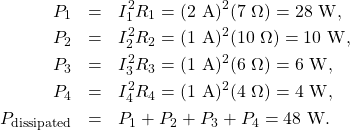
The total free energy is constant in any process. Therefore, the ability supplied by the voltage source is  . Analyzing the power supplied to the circuit and the power dissipated by the resistors is a good check for the validity of the assay; they should be equal.
Instance half-dozen.2.3
Combining Serial and Parallel Circuits
Figure six.two.6 shows resistors wired in a combination of serial and parallel. We tin consider to be the resistance of wires leading to and (a) Discover the equivalent resistance of the circuit. (b) What is the potential drop  across resistor ? (c) Notice the current
  through resistor . (d) What ability is dissipated by ?
(Figure 6.2.6) 
Strategy
(a) To find the equivalent resistance, starting time discover the equivalent resistance of the parallel connectedness of and . Then use this effect to find the equivalent resistance of the series connection with .
(b) The current through can exist found using Ohm'due south law and the voltage applied. The current through is equal to the electric current from the battery. The potential drib across the resistor (which represents the resistance in the connecting wires) can be found using Ohm'south law.
(c) The current through tin can be found using Ohm'south police force  . The voltage beyond can be establish using
  .
.
(d) Using Ohm's law  , the power dissipated by the resistor tin can besides be found using
 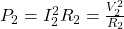 .
.
Solution
a. To find the equivalent resistance of the excursion, notice that the parallel connection of R 2 R2 and R 3 R3 is in serial with R 1 R1 , so the equivalent resistance is
![\[R_{\mathrm{eq}}=R_1+\left(\frac{1}{R_2}+\frac{1}{R_3}\right)^{-1}=1.00~\Omega+\left(\frac{1}{6.00~\Omega}+\frac{1}{13.00~\Omega}\right)^{-1}=5.10~\Omega.\]](https://openpress.usask.ca/app/uploads/quicklatex/quicklatex.com-e349541d471bbeb1e596688bf8d5f9fb_l3.png "Rendered by QuickLaTeX.com")
The total resistance of this combination is intermediate between the pure series and pure parallel values ( and
and  , respectively).
b. The electric current through is equal to the current supplied by the battery:
![\[I_1=I=\frac{V}{R_{\mathrm{eq}}}=\frac{12.0~\mathrm{V}}{5.10~\Omega}=2.35~\mathrm{A}.\]](https://openpress.usask.ca/app/uploads/quicklatex/quicklatex.com-bc5d62d11860c0e0d39ab7448c71f24c_l3.png "Rendered by QuickLaTeX.com")
The voltage across is
![\[V_1=I_1R_1=(2.35~\mathrm{A})(1~\Omega)=2.35~\mathrm{V}.\]](https://openpress.usask.ca/app/uploads/quicklatex/quicklatex.com-6285286f60b6ecbf0f70cfb897f34589_l3.png "Rendered by QuickLaTeX.com")
The voltage applied to and is less than the voltage supplied by the battery by an corporeality . When wire resistance is large, it can significantly bear upon the performance of the devices represented by and .
c. To notice the current through , we must outset notice the voltage applied to it. The voltage across the two resistors in parallel is the same:
![\[V_2=V_3=V-V_1=12.0~\mathrm{V}-2.35~\mathrm{V}=9.65~\mathrm{V}.\]](https://openpress.usask.ca/app/uploads/quicklatex/quicklatex.com-347159089f2b09a7d07f546965782d1c_l3.png "Rendered by QuickLaTeX.com")
Now nosotros can notice the electric current through resistance using Ohm'southward police:
![\[I_2=\frac{V_2}{R_2}=\frac{9.65~\mathrm{V}}{6.00~\Omega}=1.61~\mathrm{A}.\]](https://openpress.usask.ca/app/uploads/quicklatex/quicklatex.com-2c0782e3627d371bc9f3b731a8fbd6cc_l3.png "Rendered by QuickLaTeX.com")
The current is less than the  that flowed through when information technology was connected in parallel to the battery in the previous parallel circuit example.
d. The power dissipated by is given by
![\[P_2=I_2^2R_2=(1.61~\mathrm{A})^2(6.00~\Omega)=15.5~\mathrm{W}.\]](https://openpress.usask.ca/app/uploads/quicklatex/quicklatex.com-90120eb6bf6ae0b2cb5bf8df6a0a580b_l3.png "Rendered by QuickLaTeX.com")
Significance
The analysis of complex circuits can often be simplified past reducing the excursion to a voltage source and an equivalent resistance. Fifty-fifty if the entire circuit cannot be reduced to a single voltage source and a single equivalent resistance, portions of the excursion may be reduced, profoundly simplifying the assay.
Cheque YOUR Agreement vi.5
Consider the electrical circuits in your abode. Give at least two examples of circuits that must use a combination of series and parallel circuits to operate efficiently.
Practical Implications
One implication of this last case is that resistance in wires reduces the electric current and power delivered to a resistor. If wire resistance is relatively large, equally in a worn (or a very long) extension cord, then this loss can be significant. If a large electric current is drawn, the  drib in the wires tin can also be significant and may get credible from the rut generated in the cord.
For example, when you are rummaging in the refrigerator and the motor comes on, the refrigerator light dims momentarily. Similarly, you can see the rider compartment light dim when y'all start the engine of your car (although this may be due to resistance inside the battery itself).
What is happening in these high-current situations is illustrated in Effigy vi.ii.7. The device represented by has a very low resistance, and then when it is switched on, a large current flows. This increased electric current causes a larger driblet in the wires represented by , reducing the voltage across the light seedling (which is ), which then dims noticeably.
(Figure half-dozen.two.7) 
Trouble-Solving Strategy: Series and Parallel Resistors
- Depict a clear circuit diagram, labeling all resistors and voltage sources. This step includes a list of the known values for the problem, since they are labeled in your excursion diagram.
- Identify exactly what needs to be determined in the problem (identify the unknowns). A written list is useful.
- Determine whether resistors are in series, parallel, or a combination of both series and parallel. Examine the circuit diagram to make this assessment. Resistors are in series if the aforementioned current must pass sequentially through them.
- Use the appropriate list of major features for series or parallel connections to solve for the unknowns. There is one listing for series and another for parallel.
- Cheque to meet whether the answers are reasonable and consequent.
EXAMPLE 6.2.4
Combining Series and Parallel Circuits
Two resistors continued in series  are connected to 2 resistors that are connected in parallel
  . The series-parallel combination is continued to a bombardment. Each resistor has a resistance of
  . The wires connecting the resistors and battery take negligible resistance. A electric current of runs through resistor . What is the voltage supplied past the voltage source?
Strategy
Use the steps in the preceding trouble-solving strategy to find the solution for this example.
Solution
- Depict a clear circuit diagram (Figure 6.2.8).
(Effigy 6.ii.8)

Effigy six.2.eight To find the unknown voltage, we must commencement find the equivalent resistance of the excursion. - The unknown is the voltage of the bombardment. In order to find the voltage supplied by the battery, the equivalent resistance must be found.
- In this circuit, nosotros already know that the resistors and are in series and the resistors and are in parallel. The equivalent resistance of the parallel configuration of the resistors and is in series with the series configuration of resistors and .
- The voltage supplied past the battery can be plant by multiplying the electric current from the battery and the equivalent resistance of the circuit. The electric current from the bombardment is equal to the current through and is equal to . We need to notice the equivalent resistance by reducing the circuit. To reduce the circuit, first consider the ii resistors in parallel. The equivalent resistance is
 . This parallel combination is in series with the other two resistors, and so the equivalent resistance of the circuit is
  . The voltage supplied by the battery is therefore
  .
. - I mode to cheque the consistency of your results is to calculate the power supplied by the battery and the power prodigal past the resistors. The power supplied by the battery is
![\[P_{\mathrm{batt}}=IV=100.00~\mathrm{W}.\]](https://openpress.usask.ca/app/uploads/quicklatex/quicklatex.com-6ed928572dc11ad1dc7186110001b876_l3.png "Rendered by QuickLaTeX.com")
Since they are in series, the current through
equals the electric current through . Since  , the electric current through each will be
  . The power dissipated by the resistors is equal to the sum of the power dissipated by each resistor:

Since the power dissipated past the resistors equals the ability supplied by the bombardment, our solution seems consistent.
Significance
If a problem has a combination of series and parallel, as in this example, it can be reduced in steps by using the preceding trouble-solving strategy and by considering individual groups of serial or parallel connections. When finding for a parallel connexion, the reciprocal must be taken with care. In addition, units and numerical results must be reasonable. Equivalent series resistance should be greater, whereas equivalent parallel resistance should be smaller, for example. Ability should exist greater for the same devices in parallel compared with serial, then on.
Candela Citations
CC licensed content, Specific attribution
- Download for complimentary at http://cnx.org/contents/7a0f9770-1c44-4acd-9920-1cd9a99f2a1e@8.1. Retrieved from: http://cnx.org/contents/7a0f9770-1c44-4acd-9920-1cd9a99f2a1e@8.one. License: CC Past: Attribution
duquettehavol1984.blogspot.com
Source: https://openpress.usask.ca/physics155/chapter/6-2-resistors-in-series-and-parallel/
0 Response to "Why Must a Capacitor Be in Front Resistor to Read the Voltage Drop of the Resistor"
Publicar un comentario