Art Activity Superficial Muscles of the Posterior Thorax and Shoulder Acting on the Scapula and Arm
Clarification [edit | edit source]
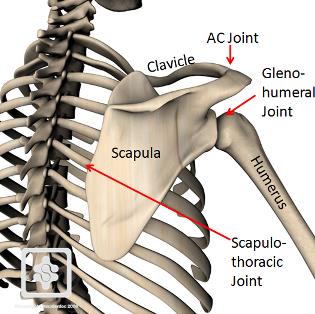
- The Scapulothoracic (ST) "joint" is not a truthful anatomic joint as it has none of the usual joint characteristics (matrimony by fibrous, cartilaginous, or synovial tissues).
- It is an articulation of the scapula with the thorax which depends on the integrity of the anatomic Acromioclavicular (Ac) and Sternoclavicular (SC) joints.
- The SC and AC joints are interdependent with the ST joint because the scapula is attached by its acromion process to the lateral terminate of the clavicle & through the AC articulation; the clavicle, in turn, is fastened to the axial skeleton at the manubrium of the sternum through the SC joint.
- Any motion of the scapula on the thorax must result in movement at either the AC joint, the SC joint, or both; that is, the functional ST articulation is part of a true closed chain with the Air conditioning and SC joints and the thorax. [one]
Resting position of the Scapula [edit | edit source]
- Usually, the scapula rests at a position on the posterior thorax approximately ii inches from the midline, betwixt the 2nd through seventh ribs (scapula extends from the level of T2 barbed process to T7 orT9 barbed process, depending on the size of the scapula)[two] and the medial border is near 6 cms lateral to the spine.
- The scapula also is internally rotated xxx° to 45° from the coronal plane, is tipped anteriorly approximately 10° to 20° from vertical, and is upwardly rotated ten° to 20° from vertical.[3] The magnitude of upward rotation has every bit its reference a "longitudinal" axis perpendicular to the axis running from the root of the scapular spine to the Air conditioning joint.
- If the vertebral or medial border of the scapula is used as the reference axis, the magnitude of upwards rotation at balance is usually described every bit 2° to 3° from vertical.[four] Although these "normal" values for the resting scapula are cited, substantial individual variability exists in scapular rest position, fifty-fifty among healthy subjects. [4][ane][v]
Part [edit | edit source]
Motions Available [edit | edit source]
Movements of scapulothoracic joint are a very important element of shoulder kinesiology. The wide range of motion bachelor to the shoulder joint is due to the large movement available at ST joint.[5]
Ascertainment and measurement of individual SC and AC articulation motions are more hard than observing or measuring motions of scapula on the thorax. Consequently, ST position and motions are described and measured far more frequently than are the SC and Air-conditioning joint motions upon which ST motions are dependent.[ane]
The motions of the scapula from the resting or reference position includes three rotations that occur at the Air conditioning joint. These are:
- Upward/downward rotation
- Internal/external rotation
- Inductive/posterior tipping.
Of these three Ac joint rotations, only upward/downwards rotation is readily observable at the ST, and it is therefore considered to be a "primary" scapular move. Internal/external rotation and anterior/posterior tipping are normally difficult to observe and are therefore considered to exist "secondary" scapular motions.
The scapula also has available translatory motions of scapular elevation/depression and protraction/retraction. The linkage of the scapula to the AC and SC joints prevents scapular motions both from occurring in isolation and from occurring every bit true translatory motions. Instead, scapular motions on the thorax must occur in combinations, such as the simultaneous upward rotation, external rotation, and posterior tipping that occur when the arm is abducted.
- Elevation & Depression
Commonly described equally translatory motions in which the scapula moves upward (cephalad) or downward (caudally) along the rib cage from its resting position.[1]
These motions at ST joint occurs as a composite of SC and Air conditioning joint rotations.
The motility of shrugging the shoulders which involves scapular summit occurs equally a issue of scapula post-obit the path of elevating clavicle about the SC joint and requires subtle adjustments in anterior/posterior tipping and internal/external rotation at the AC articulation to maintain the scapula in contact with the thorax. [1] [5]
Depression of the scapula at the ST joint occurs every bit the activeness reverse to that of elevation.[v] - Protraction & Retraction
Protraction is a summation of horizontal plane rotations at both the SC and AC joints.[5]These are translatory motions of the scapula away from or toward the vertebral column, respectively. However, if protraction of the ST joint occurred as a pure translatory movement, the scapula would movement directly away from the vertebral column, and the glenoid fossa would face laterally.Simply the vertebral border of the scapula would remain in contact with the rib cage. Even so, in reality, full scapular protraction results in the glenoid fossa facing anteriorly with the full scapula in contact with the rib muzzle. The scapula follows the profile of the ribs by rotating internally and externally at the Air-conditioning articulation in combination with clavicular protraction and retraction at the SC joint.[one]
The scapula follows the general path of the protracting clavicle about the SC joint. SC protraction increases the extent of forward achieve.
As SC protraction occurs as a summation of both SC and Air-conditioning joint, a decrease in motion at one joint can be atleast partially compensated past an increase at the other. For case, in example of astringent degenerative arthritis and decreased motion at Air conditioning joint, the SC articulation may compensate by contributing a greater degree of protraction, thereby limiting the extent of loss of forwards attain of upper limb. [five]
Retraction occurs in a similar but reverse style as protraction. Retraction of the scapula is frequently performed in the context of pulling an object towards the body.[five] - Upwardly & Downwardly Rotation
Upward rotation of the scapula on the thorax is the chief move of the scapula observed during agile elevation of the arm and plays a significant role in increasing the range of tiptop of the arm overhead.[ane] This move places the glenoid fossa in a position to support and stabilize the head of the raised humerus.[5] Approximately 60° of up rotation of the scapula on the thorax is typically available. Given the closed-concatenation relationship between the SC, Air-conditioning, and ST joints, differing proportions of upward/downward rotation of the scapula are contributed past SC joint meridian/ depression, SC joint posterior/anterior rotation, and by Ac join upward/downward rotation.[one]
Downwards rotation of the scapula occurs every bit the arm is returned to the side from a raised position. The motion is described like to upward rotation, except that the clavicle depresses at the SC articulation and the scapula downwardly rotates at the AC joint. The motion of downward rotation usually ends when the scapula has returned to its anatomic position.[5]
- Internal/External Rotation
The scapular motions of internal and external rotation are normally identifiable on physical ascertainment but are critical to its movement along the curved rib cage. These movements normally accompany protraction/ retraction of the clavicle at the SC joint. Internal rotation of the scapula on the thorax that is isolated to (or occurs excessively at) the AC articulation results in prominence of the vertebral edge of the scapula as a effect of loss of contact with the thorax. This is often referred to clinically as scapular "winging". Excessive internal rotation may be indicative of pathology or poor neuromuscular control of the ST muscles.[i] - Anterior/Posterior Tipping
This motion is too normally not overtly obvious on clinical ascertainment and is critical to maintaining contact of the scapula confronting the curvature of the rib cage. It occurs at the AC joint and ordinarily accompanies inductive/posterior rotation of the clavicle at the SC joint. Anterior tipping that is isolated to or occurs excessively at the Air conditioning articulation volition result in prominence of the inferior bending of the scapula. An anteriorly tipped scapula may occur in pathologic situations (poor neuromuscular command) or in abnormal posture.[1]
Scapulothoracic Stability [edit | edit source]
Stability of the scapula on the thorax is provided past the structures that maintain integrity of the linked AC and SC joints. The muscles that attach to both the thorax and scapula maintain contact between these surfaces while producing the movements of the scapula. In addition, stabilization is provided through the ST musculature past pulling or compressing the scapula to the thorax.[6][1]
The ultimate functions of scapular motion are to orient the glenoid fossa for optimal contact with the maneuvering arm, to add together range to elevation of the arm, and to provide a stable base of operations for the controlled motions between the humeral head and glenoid fossa. The scapula, with its associated muscles and linkages, per-forms these mobility and stability functions so well that it serves as a premier instance of dynamic stabilization in the human trunk.[ane]
Airtight and Open Packed Position
[edit | edit source]
Considering it is not a true articulation, it does not have a capsular blueprint nor a close packed position.[2]
Resting Position [edit | edit source]
The resting position of this joint is the same as for the acromioclavicular joint i.east arm by side.[two]
References
[edit | edit source]
- ↑ 1.00 one.01 1.02 1.03 1.04 one.05 1.06 1.07 1.08 1.09 1.x ane.11 Levangie, P.M. and Norkin, C.C. (2005). Joint structure and function: A comprehensive assay (4th ed.). Philadelphia: The F.A. Davis Company.
- ↑ ii.0 2.1 2.2 Magee DJ. Orthopaedic Physical Assessment. 5th ed. Canada: Elsevier; 2006
- ↑ Ludewig P, Cook T. Alterations in shoulder kinematics and associated musculus activeness in people with symptoms of shoulder impingement. Phys Ther 2000;lxxx:276–291
- ↑ 4.0 4.1 Ludewig P, Cook T, Nawoczenski D. Three dimensional scapular orientation and muscle activity at selected positions of humeral elevation. J Orthop Sports Phys Ther 1996;24:57–65
- ↑ five.0 v.1 5.two 5.three v.4 5.5 5.6 5.seven 5.viii Neumann DA. Kinesiology of the musculoskeletal organization: Foundations for Concrete Rehabilitation.2nd Ed.Elsevier Health Sciences;2009
- ↑ Van der Helm F, Pronk, G: Three-dimensionalfckLRrecording and clarification of motions of the shoul-der mechanism. J Biomech Eng 1995; 117:27–40
duquettehavol1984.blogspot.com
Source: https://www.physio-pedia.com/Scapulothoracic_Joint
0 Response to "Art Activity Superficial Muscles of the Posterior Thorax and Shoulder Acting on the Scapula and Arm"
Publicar un comentario